
Professional Development
Ensuring successful implementation through literacy coach training
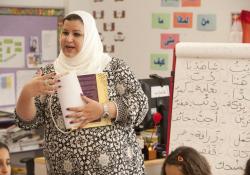
The Arabic Literacy Coaching Program is designed to provide each participant with the skills and knowledge needed to become Arabic Language leaders in their respective schools. Participating teachers should be committed to enhancing their professional practice in Arabic and in performing an advocacy role in their school for systemic program improvement and reform.
The coaching program and training sessions take place at Riffa Views International School in Bahrain (an ISS Managed School). Teachers enrolled in the program are required to attend eight 4 or 5 day training sessions in Bahrain during the course of the two year program.
The literacy coach training program consists of 8 modules of 30 hours. We are working to gain certification for the program. Trainee coaches are expected to attend all four/five days of each module and to complete required assignments. There are also two site visits during the course of each year of the pilot in which a team member will spend one/two days coaching and guiding the implementation in each school.
The Arabic literacy coaching model consists of 8 modules. Each module is comprised of 30 hours of training. The modules are as follows:
- Foundational Knowledge
- The Classroom Environment
- Standards-based Assessment
- Literacy Coaching Essentials
- Standards-based Instruction
- Reading workshop
- Writing workshop
- Professional Learning and Leadership within a school community
Pilot Schools
Ongoing professional development is strongly recommended to ensure successful implementation of the program. Core professional development for implementation is listed in the tables below. Courses may be modified to target the specific needs of schools. The WLI has a team of trainers who can offer the following:
Introduction to Qisas for native Arabic Learners
(1-2 day intro)
- Literature-based program
- Introduction to standards
- Unit design
- Genres
- Assessments
- Instructional strategies
Deeper understanding of the Arabic standards for native learners
1-2 days
- Arabic language arts standards, benchmarks and performance indicators
- Standards-based unit planning
Literature based Arabic language arts
1-2 days
Reading:
- The 4 types of reading.
- Strategies: SQ3R, etc.
- Text types: Authentic vs. contrived. Original vs. translated
- Classroom libraries and genre based curricula
Writing:
- Journals
- Audience and purpose
- 6+1 traits
- The reading-writing connection
Assessment for learning
1-2 days
Standards-based assessment
- Diagnostic
- Formative
- Summative
- Standardized
Needs assessment
1-2 days
Establish a baseline and growth targets to guide program implementation and development over time. Critical elements for successful program implementation have been identified based on the Danielson Framework for Teaching. These are assessed through observations and interviews.
All trainings balance theoretical content with practical implementation and where possible include modeling, observation, coaching and feedback
“In this training, I found comfort in knowing that I am not the only one who finds difficulty in teaching students with different capabilities in the same class, I used to give all the students the same tasks even though I knew that some of them found it difficult to understand what was being given to them. Now, I try different activities, modeling and mini-lessons. I also try to read a book with them daily.”
WLI Arabic Pilot Program Participant


- Home
- Blog
- Contact
- info@isswli.org
- Follow Us


- All Rights Reserved ©2012 International Schools Services
- Privacy Notice
- Terms and Conditions of Service