
Program Overview
Currently, the WLI is primarily focused on two programs: the Native and Non-Native Arabic Programs, and the English as Additional Language (EAL) Pilot Program at select “Catalyst” schools in China.
The WLI Arabic Programs:
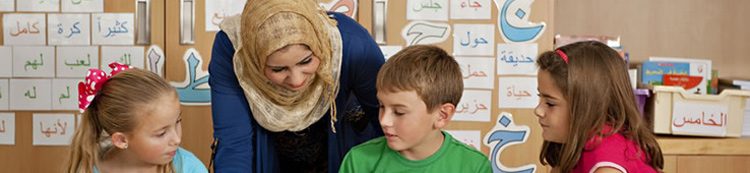
As ISS continues to develop schools in the Middle-East region, it has resolved to seek solutions to existing challenges and to foster the development of high quality, sustainable Arabic language programs for schools. In collaboration with Dr. Hanada Taha-Thomure, Associate Dean of Bahrain Teachers’ College at the University of Bahrain, and a team of experts, they set out to craft a new vision for Arabic language learning at Riffa Views International School in Bahrain and the KAUST School in Saudi Arabia. The result was the creation of the native (Qisas) and non-native (Hiwaraat) programs, which form the core of the initiative.
- Qisas (Stories) for native language learners is literature based and aligned with the ISS Arabic Standards. The program uses a range of resources rather than a specific textbook. The resources include a large collection of authentic children's literature and student resource books. Such resources offer learners a rich linguistic experience that focuses on teaching them to read independently, comprehend, discuss, analyze, research, and synthesize using Modern Standard Arabic.
- Hiwaraat (Dialogues) for non-native language learners aims to equip students with language skills and tools that enable them to function and be able to communicate with Arabic speakers, and to promote mutual understanding of and respect for the Arab culture.
These new instructional programs form the core of a comprehensive framework of components designed to support and sustain critical shifts towards best practices in Arabic language learning.
Read more about the WLI Arabic programs
English as Another Language (EAL) Pilot Program
Through its new pilot program, the WLI is taking on the challenge of developing exemplary EAL policies, programs, and practices at two “Catalyst” school sites where the overwhelming majority of students come from non-English backgrounds. Nansha College Preparatory Academy (NCPA) and the International School of Dongguan (ISD) in China - are building linguistically- and culturally-responsive policies along with enriched approaches to curriculum design and instructional delivery that intertwine English-language development across all content areas. These approaches help students learn to use language and literacy to master academic content, think creatively and critically, collaborate, and self-reflect beyond the classroom as a means for shaping a global perspective.

- Home
- Blog
- Contact
- info@isswli.org
- Follow Us


- All Rights Reserved ©2012 International Schools Services
- Privacy Notice
- Terms and Conditions of Service