
More Than 60 Educators and Administrators Convene In China for the Newly Launched, Pioneering ISS WLI Certification Program for English as an Additional Language (EAL)
September 10, 2014
In response to the continued changing demographic of international schools, ISS proudly launched its EAL certification program August 4-8th, 2014, at Nansha College Preparatory Academy (NCPA) as a way to make a reality of the oft- quoted mantra, “all teachers are EAL teachers” by preparing them with the knowledge, capacities, and skills necessary to provide research-based and responsive learning experiences for English learners in all classrooms.
The first course – Teaching English as an Additional and Academic Language (TEAAL) – took place in the inspiring E-Learning Center at Nansha College Preparatory Academy (NCPA) in China. Sixty teachers, three ISS senior administrators, and two school directors gathered during the week of August 4th through August 8th 2014, from 8:00 am to 5:00 pm for a total of forty contact hours. They hailed from NCPA and from the nearby International School of Dongguan (ISD), though one adventurer journeyed from the American International School of Budapest. Graduate credit was provided through Seton Hall University of New Jersey.
While new staff were becoming accustomed to a new country and school, returning staff were greeted by several buildings newly constructed over the summer. The two groups were easy to distinguish: the veterans swapped summer vacation stories and pictures while the newcomers scanned the assembled crowd, chitchatting with strangers on the usual topics: Where are you from? What school were you at last? When did you get here? The first day of the initial course of the ISS WLI EAL certification program had officially begun.
Under the guidance of the course instructor Dr. Gini Rojas, four EAL specialists – Ms. Kim Ariail and Ms. Keisha LaBeach of ISD, and Ms. Beth Puma and Ms. Anni Sherman of NCPA – facilitated the interactive afternoon sessions, allowing for differentiated groupings to plan direct application to classroom lessons. At times, these sessions were driven by subject areas and grade levels while, at other times, teachers self-selected their sessions by interest or by their own skill level. This structure established a learning environment conducive to active participation within and across divisions and schools. As the EAL co-facilitators commented, “We noticed that the afternoon areas of inquiry were more authentic; for example, participants posed precise questions and requests related to their teaching. We also observed that by using these questions to clarify understanding and encourage participants to negotiate meaning within their partner or small group discussions, the afternoon sessions promoted deeper understanding of how and why EAL strategies are so important.”
The course syllabus was designed around current principles of second language acquisition, bilingualism, and effective instruction for English learners; namely, the January 2013 six key principles for ELL instruction (http://ell.stanford.edu), the research-based principles for sheltered instruction (www.cal.org), the guiding principles of language development (www.wida.org), and the Teachers of English to Speakers of Other Languages’ standards for P–12 ESL Teacher Education Programs (www.tesol.org). Each day focused on a teacher toolkit of specific strategies including ways to purposefully integrate students’ primary languages and cultures as ‘entry points,’ the intentional scaffolding of academic language and literacy around oral and written formative and summative assessments, and differentiation not of expectation but of language usage based on learners’ current and, more importantly, progressive levels of English proficiency. The end of the week celebrated paths for continued collaboration among classroom teachers and EAL specialists including co-planning content and language targets and possible co-teaching models.
An overarching goal of the week was to emphasize the distinction between a medical vs. ecological model of EAL programming in international schools: the first continues to relegate English learners as problems to be ‘fixed’ by EAL specialists while the latter commits to the value-addedness that linguistic and cultural diversity brings to international schools and therefore empowers all teachers and administrators to hone their knowledge, skills, and dispositions to support English learners in academically-robust mainstream classrooms. ISS schools acknowledge that this journey will be transformative of who they are as teachers, school communities as a whole, and each of us as learners and invite those interested to join its EAL certification program.
Several teachers shared comments on their experiences of the week:
• “The week was valuable to me because it gave me a chance to see some models of the teaching strategies we are being encouraged to use in our classrooms. It gave me some insight into how I could use these models in my classroom on a daily basis. It was also nice to be able to plan some actual lessons and get feedback from my peers and the facilitators running the workshop.” Jon Lind, Secondary Math ISD teacher.
• “I have a lot more strategies in my toolbox to use for scaffolding and differentiating for all my students. It was valuable to participate in some of the ELL strategies as a student, because I gained some insight into what my students will be able to get out of it.” Teryn Garberg, 3rd grade ISD teacher.
• “I flew all the way from Budapest to China to take this EAL course. It was a unique learning experience wherein I was able to delve into the world of teaching English learners and mingle with others who were all invested in learning how to be the best teacher to the students who desperately need us to know how best to reach them. I was not disappointed and am planning on finishing not only the ISS EAL certificate but also the master’s degree with Seton Hall University.” Heather Sinclair, EAL Coordinator, AISB.
• “We feel that this workshop fostered not only our own professional growth but also that of the international teachers who attended. At the end of the day, we knew we had successfully implemented the TEAAL objectives when various teachers approached us asking for advice or to simply converse about how to ensure consistent use of best practices in their classes.” EAL Co-Facilitators, ISD & NCPA.
For more information about the World Language Initiative and its EAL program, please visit http://www.isswli.org/eal or contact Dr. Gini Rojas at vprojas@aol.com

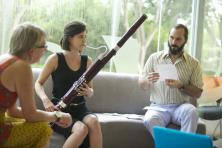
Dr. Gini Rojas works with first ISS certificate program participants on EAL instruction strategies

ISS EAL Certificate Program Participants, August 4-8th, 2014, NCPA (China)

ISS EAL Certificate Program Participants, August 4-8th, 2014, NCPA (China)

ISS EAL Certificate Program Participants, August 4-8th, 2014, NCPA (China)

ISS EAL Certificate Program Participants, August 4-8th, 2014, NCPA (China)

ISS EAL Certificate Program Participants, August 4-8th, 2014, NCPA (China)

- Home
- Blog
- Contact
- info@isswli.org
- Follow Us


- All Rights Reserved ©2012 International Schools Services
- Privacy Notice
- Terms and Conditions of Service