Seeking Solutions for Language Learners

January 24, 2013
Bridget Doogan, ISS Consultant

“The limits of my language are the limits of my universe.”
- Ludwig Wittgenstein

ISS established the World Language Initiative (WLI) to assist international schools in meeting the complex challenges they have long faced when it comes to offering host-county language programs. While providing such programs to non-native learners was generally seen as a desirable, if not critical element of a school’s curriculum, implementation was often fraught with challenges. Whether it was Japanese, Mandarin or Arabic, finding programs well aligned with the pedagogical norms of international schools, as well as teachers who were willing and able to adapt to these norms proved difficult. Language courses were often introduced in middle school, and frequently offered on an optional basis. All too often this gave rise to fragmented programs resulting in low levels of achievement and high levels of frustration. In the Arab world in particular, this situation has been compounded in recent years as demographic shifts and the search for quality schools have drawn increasingly high percentages of host-country nationals into English medium and international schools around the Middle East region. Nowadays, student populations often include significant ratios of both native and heritage Arabic language learners1. The American Council for the Teaching of Foreign Languages (ACTFL) asserts, “It is critical that these students be able to continue to develop their heritage linguistic and cultural skills in order to become fully bilingual and biliterate in today’s global environment.”2 Furthermore, for schools who embrace 21st century aspirations towards internationalism and global citizenship, supporting student learning of the host country language has become essential. As schools strive to meet the diverse linguistic needs of their native, heritage and non-native Arabic learners they have turned towards best practices offered by ACTFL and other language organizations to guide them. Teachers have faced significant challenges, including:
  • The lack of quality professional development (in both language and pedagogy)
  • The lack of unifying standards for each distinct linguistic population
  • Common agreements on the use of Modern Standard Arabic (MSA)
  • Common agreements on best practices for language learning
  • Lack of quality instructional resources
  • Fragmented professional community
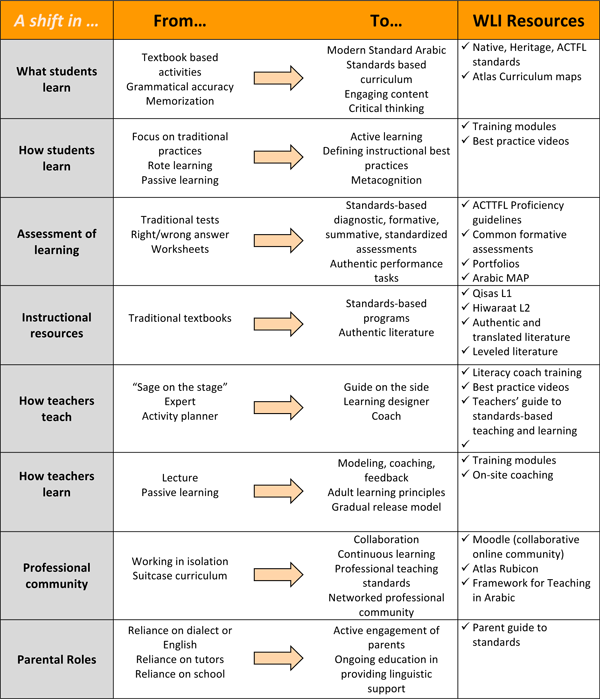
Without the validation of unifying standards and agreed-upon achievement measures, innovative practices proved hard to sustain. Furthermore, in the absence of a supporting research base, often they can be difficult to justify to teachers and parents. It is into this challenging professional landscape that the WLI ventured. As ISS continues to develop schools in the middle-east region, it has resolved to seek solutions to these challenges and to foster the development of high quality, sustainable Arabic language programs for schools. In collaboration with Dr. Hanada Taha-Thomure, Associate Dean of Bahrain Teachers’ College at the University of Bahrain, and a team of experts, they set out to craft a new vision for Arabic language learning at Riffa Views International School in Bahrain and The KAUST School in Saudi Arabia. The result was the creation of the native program, Qisas and non-native program Hiwaraat which form the core of the initiative. Qisas (Stories) for native language learners is literature based and aligned with the ISS Arabic Standards. The program uses a range of resources rather than a specific textbook. The resources include a large collection of authentic children's literature and student resource books to extend the work in the genres. Such resources offer learners a rich linguistic experience that focuses on teaching them to read independently, comprehend, discuss, analyze, research, and synthesize using Modern Standard Arabic. Hiwaraat (Dialogues) for non-native language learners aims to equip students with language skills and tools that enable them to function and be able to communicate with Arabic speakers, and to promote mutual understanding of and respect for the Arab culture. These new instructional programs form the core of a comprehensive framework of components designed to support and sustain critical shifts towards best practices in Arabic language learning.

Figure 1: A Multi-faceted Approach to Arabic Language Teaching and Learning


In 2011, a wider cohort of schools was invited into an expanded pilot program, including 15 international schools and one national school in the Gulf region, from Saudi Arabia, Qatar, Bahrain, and Oman. The schools committed to implement the program in its current form, to participate in literacy coach training, and to collaborate with one another as a professional learning community with the goal of refining the program. A prominent element was participation in the first Arabic literacy coach training program. A cohort of 30 trainee literacy coaches is approaching the mid-point of a two-year training program comprised of eight 4-day modules designed to hone their pedagogical and linguistic skills, and skill them to coach and mentor their colleagues as they implement the new curriculum in their schools. Ensuring quality is a key concern. The developing program is being audited by Dr. Dany Doueiri, Assistant Professor and Coordinator of Arabic Language Programs, California State University, San Bernardino, who has already given some preliminary feedback, stating, “I would like to congratulate you on the extensive work you have developed for the Arabic language program. The documents are truly amazing and comprehensive. They must have taken months and months to conceptualize, plan, research, draft, and complete. Having interacted with other Arabic programs in the Arab region, I can assure you that you are setting very high standards that many existing schools in the region should carefully look at to learn from, and hopefully one day implement and adopt in their own classrooms.” The program is also being overseen by an advisory board of eminent authorities in the field. Efforts are underway to partner with assessment agencies to begin gathering performance data on student achievement, including NWEA with whom we are working to develop an- Arabic MAP assessment. This data will help inform a long term research project that is being designed to gauge the impact of the program design on student achievement. While there is much work to be done, early results are encouraging. As the model continues to be tested and refined, the premise of the WLI – that the approach can be replicated and applied to other language contexts – primarily ELL and Mandarin, remains a long-term goal. In the short term completing the publication of instructional materials, and the second year of the pilot over the next twelve months will represent a milestone worth a celebrating.
  1. “Students raised in a home where a non-English language is spoken by one who speaks or merely understands the heritage language, and who is to some degree bilingual in English and the heritage language.” AATSP Professional Development Series Handbook for Teachers K–16: Vol 1. 2000. Thomson Publishing. Andover, Hampshire.
  2. American Council for the Teaching of Foreign Languages, Position Statement. 2005. www.actfl.org.